|
During the past two weeks, I answered a lot of interview questions and mini Q&As for different magazines and blogs. I noticed a recurring question. The question was: "what advice do you have for aspiring writers?" You must understand that I'm not in the position to give any advice on how to run a writing career; what I've got going has none of the constructs of a career. I haven't even formally studied writing. I'm more of a marginally skilled hobbyist, a writer version of a bonsai-keeper. Training a bonsai tree to take on a certain styling specific to its species, to miniaturize it, to constrict its posture to reflect the extreme conditions of nature (drought, growing on a rock face, etc.) -- these designs take years to "inflict" on a bonsai tree. Thus, if you are a beginner, you must start with a banyan tree. That's the easiest to train. A beginner can air layer it with ease. And since we're incredibly off track here, let me start another paragraph. :) Now, some highly-skilled bonsai experts have an eye for styling, and they produce little trees that preen on red-carpeted bonsai showrooms and simulated garden exhibits. Their training techniques are difficult to replicate because those take introspection and daring. On the other hand, there are people who are very interested in cultivating bonsai, but their stunted little trees are only meant to be displayed in their backyards (flaws like overgrown roots, over-watering leading to defoliation, wiring marks, etc. indicate amateurish techniques). I'm the bonsai-keeper who is between the backyard and the showroom. So, taking note of my qualifications and the lack thereof, I write my unsolicited advice as: 1. Remember your chemistry. From a saturated solution kept in the right conditions, you can either obtain a mass of many small crystals or one large crystal. But take note that when a lot of small crystals are present in the solution, they will prevent the formation of bigger crystals. This is a worn writing advice, but it's effective. Solitude will help your writing. I don't mean that in the physical sense (although I'm a poster girl for antisocial behavior), but mentally distancing yourself from norms (the today-I'll-write-some-YA-slapdash-pseudo-tale-because-that's-what-everyone-is-doing sort of thing) can help you produce good material. You write the best you can, then you find a legitimate publisher to stand by your every word. 2. If you can help it, don't self-publish. I buy a lot of self-published books, but only from writers whose work I've already encountered in traditional outlets like magazines and journals. I count nineteen of the authors (whose writing I admire) who self-published at some point. For me, self-publishing is just too easy -- slap on a cover, buy an ISBN, then upload. My writing goals are different. 3. Read a lot. Read what your contemporaries produce. 4. Eat a lot of vegetables, and never ever overcook them. 5. If you have a librarian status in Goodreads, then you must help other writers to upload their books. You don't need the author's permission. I do this all the time. There are so many small press books and chapbooks that need to be listed. 6. Learn from the Japanese. Think of that exquisite, intricately windswept, meticulously structured showroom bonsai you last saw on the foyer of a five-star hotel. Remember how you couldn't take your eyes off it. You couldn't begin to imagine how to recreate it. It took, first of all, an incredible eye for mimicking the contours of nature then followed by years of wiring, training, and retraining. In between, it had to undergo a scheduled watering regime. You just don't water a bonsai like a normal plant; it's not a normal plant. It's meant to thrive on suffering: zero fertilizer, minimal soil, minimal water, plenty of wires to hold it back, more suffering, etc. There's both a science and an art to achieve something that is truly worthy of respect. That showroom bonsai, my friend, is the best and the most satisfying writing goal. This is a picture of some of the untended bonsai trees in a forgotten corner of our yard. I chose to photograph the least ugly ones, but they still looked unsightly because of neglect. The white one is an orchid. It's harmless. :) 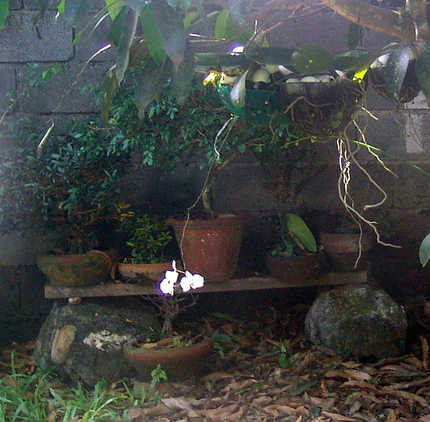 On the publishing front, there are signs of life. All is alive and kicking.
 Thank you for reading this blog entry. Have a great month ahead. P.S. And say good night to Simba sitting prettily on my reading nook inside my bedroom. This is where I read. That chair is unbelievably old and unbelievably comfy. It's one of my favorite places in the world. 
4 Comments
William Jackson
3/1/2012 04:30:27 pm
Excellent advice. Good ideas. Useful reflections. Thank you. 3/2/2012 01:31:36 am
Thank you for taking the time to comment here, William. You be well, good sir. :) Your comment will be posted after it is approved.
Leave a Reply. |
